The Quiet Compass Way

A quiet philosophy forhealthier organizations.

Misalignment inside an organization rarely arrives as a crisis. It settles in slowly — a role that quietly widens, a decision that no longer has a clear home, a rhythm that once served the work and now strains against it. By the time it is named, it has usually been felt for a long time.

The Quiet Compass Way is a way of noticing these small drifts before they harden — and a way of designing organizations so they can hold themselves steady as they grow.

Core belief

Healthy organizations are intentionally designed —not left to chance.

Culture, clarity, and coherence do not arrive on their own. They are the residue of decisions made — and unmade — over time. When leaders treat the organization itself as a thing to be designed with the same care they give their product, its people begin to move with less friction and more meaning.

Every organization expresses its design through three inseparable dimensions: the people doing the work, the processes that shape it, and the purpose that gives it direction.

The architecture of alignment

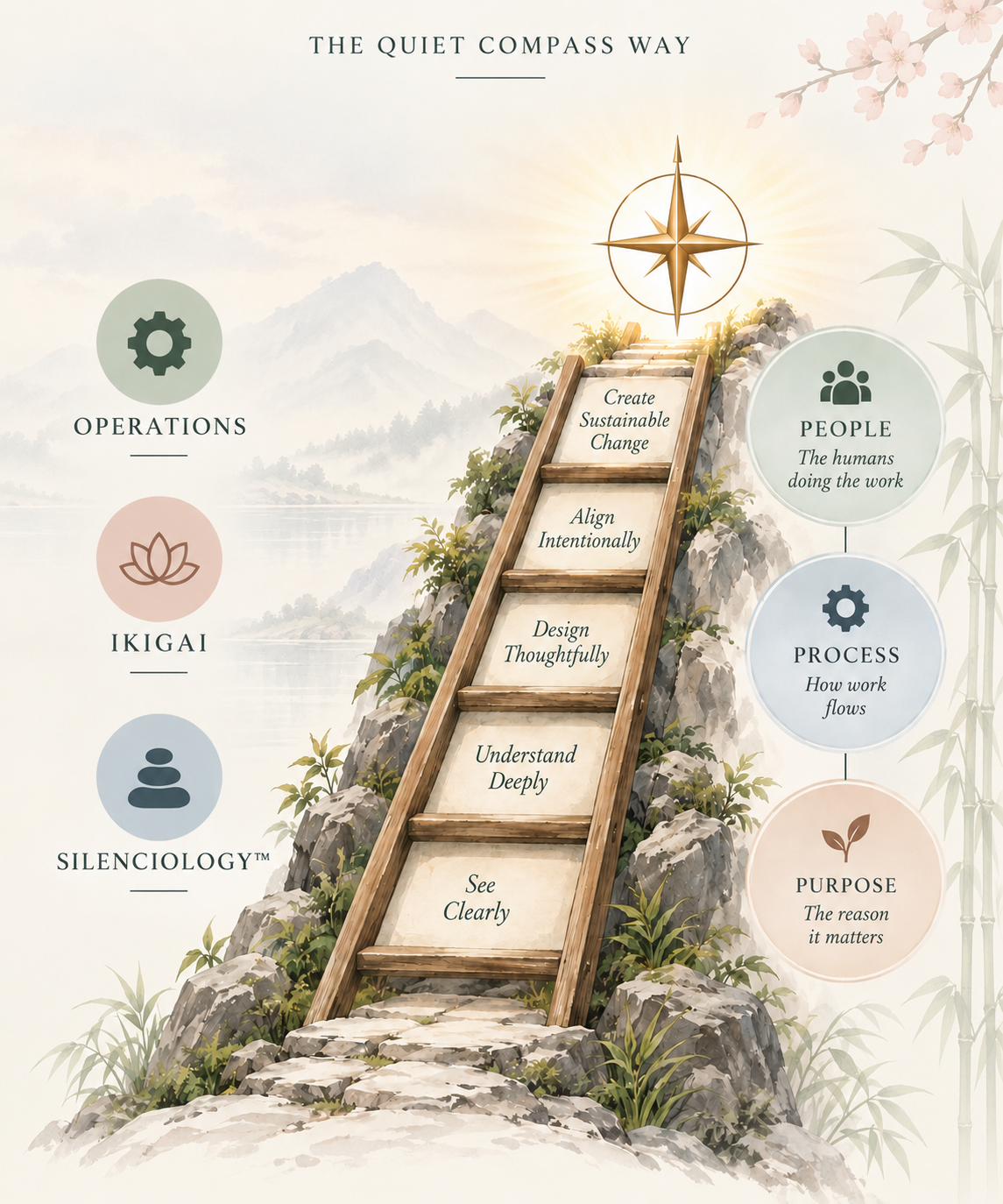
People · Process · Purpose

Not three separate concerns, but one interconnected system. When any of the three drifts, the other two quietly compensate — until the whole begins to strain in ways no single team can name.

The Quiet Compass Way: Operations, Ikigai and Silenciology lenses alongside a path of See Clearly, Understand Deeply, Design Thoughtfully, Align Intentionally and Create Sustainable Change, grounded in People, Process and Purpose.
01

People

The humans doing the work — their clarity of role, their capacity for judgment, their sense of being seen and trusted.

02

Process

The paths that decisions, information, and effort travel — where they move cleanly, and where they quietly stall.

03

Purpose

The reason the organization exists — the quiet thread that gives the other two coherence and direction.

To design for one and neglect the others is to design an organization that will eventually work against itself.

Three essential lenses

How we see the work

Each lens is a way of looking at the same organization from a different angle — and together they hold what a single perspective cannot.

    Lens 01

    Human-Centered Operations

    Systems built around the humans who use them, not around the org chart that describes them. Roles, decisions, and rhythms shaped so that judgment is trusted, effort is visible, and dignity is preserved in the ordinary shape of the work.

    Lens 02

    Silenciology™

    A discipline of listening for what an organization is not saying — the pauses in meetings, the questions that never quite land, the contributions that keep everything running but never appear on a slide. What is unspoken is often where alignment quietly fractures first.

    Lens 03

    Ikigai-inspired philosophy

    A gentle re-reading of an old idea: that meaningful work sits at the intersection of what people are good at, what the organization needs, and what quietly gives them a reason to return tomorrow. Purpose, at this scale, is not a slogan — it is a design constraint.

What we notice

The patterns that rarely make it onto a slide.

None of these are failures of character. They are the ordinary shape of an organization that has outgrown the way it was built.

  • Favoritism

    Favoritism does not always announce itself. Sometimes it appears in who is heard, protected, included, or given room to grow — and who quietly is not. Left unexamined, it creates friction long before the damage becomes visible. Favoritism is often subtle. The damage isn't.

  • Invisible contributors

    The people whose steady work holds the organization together — often the ones least likely to be named when things go well, and first to be leaned on when they don't.

  • Role erosion

    Responsibilities that quietly widen or narrow over months, until the shape of a role no longer matches the title above it or the expectations around it.

  • Chronic confusion

    The same question asked in different rooms, in different words, without a settled answer — a pattern usually treated as a communication issue when it is, more truly, a design one.

  • Uneven accountability

    Decisions that carry consequences for some and not others; efforts that are recognized in one part of the organization and quietly overlooked in another.

These patterns are rarely isolated. They usually appear together, quietly revealing that the organization is compensating for deeper misalignment.

Calm is not passive

Quiet leadership is a strategic strength.

Calm is often mistaken for absence — an unwillingness to act, a reluctance to press. In healthy organizations, it is the opposite. Calm is the discipline of thinking before moving, of listening before deciding, of distinguishing urgency from importance.

A calm organization is not a slow one. It is one where attention is protected, where decisions are made once and made well, and where people are trusted to bring their full judgment to the work in front of them.

Calm leadership looks like the ability to remain grounded, clear, and intentional — and to practice the quiet power of observation. To see beyond surface-level interactions, notice what others may overlook, and better understand the dynamics shaping a team.

This kind of leadership does not announce itself. It shows up as steadier teams, fewer avoidable crises, and a quiet compounding of clarity over time — the difference between an organization that reacts and one that actually moves toward something.
Quiet Compass Consulting

A closing thought

The work of alignment is ongoing.

Organizations are living systems. They drift, they steady, they drift again. The intention of this practice is not to arrive at a finished state — but to give leaders a way of noticing, and a way of returning to coherence when the shape of the work quietly changes.

Alignment is not a destination. It is an ongoing practice of noticing, designing, and choosing again.