People · Process · Purpose · Long-form essay
When One Drifts,
the Others Compensate
Why organizational problems rarely belong to just one part of the system.
“These dimensions rarely drift independently. When one begins to strain, the others often compensate.”
Organizations often try to solve problems in the same place where the symptom appears.
If someone is overwhelmed, we look at the person.
If work is late, we look at the process.
If people are disengaged, we look at culture or motivation.
But what if the visible problem isn’t where the problem began?
Organizations are remarkably good at compensating. When ownership is unclear, someone steps in. When a process breaks, people create a workaround. When priorities multiply, capable employees stretch a little further.
For a while, this can look like resilience. Sometimes, it is.
But sometimes, it is misalignment being quietly carried by people.
Three dimensions. One aligned system.
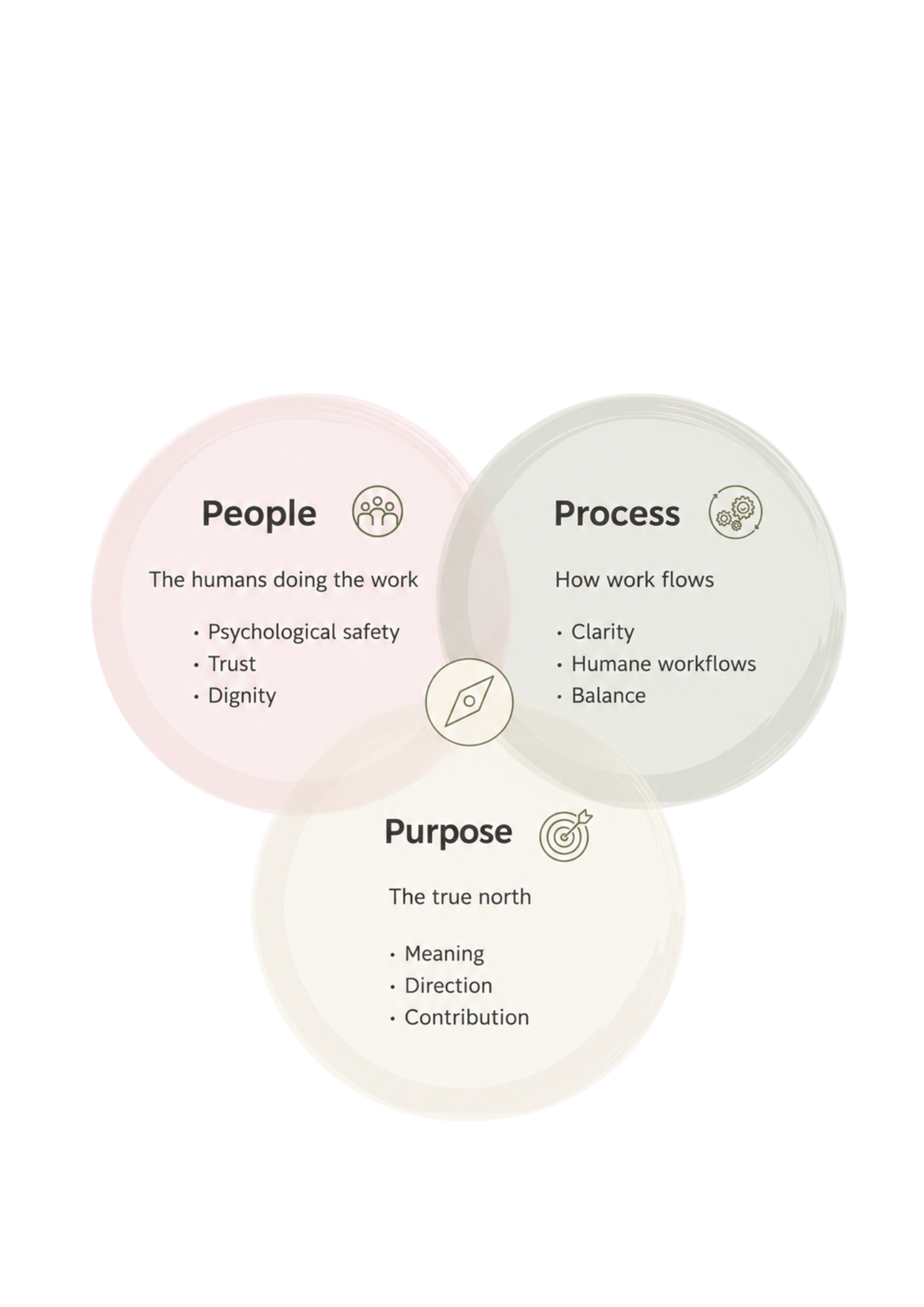
At Quiet Compass, I look at organizations through three interconnected dimensions: People, Process, and Purpose. Each has a distinct role, but none operates in isolation.
People — the humans doing the work
Psychological safety · Trust · Dignity
Process — how work flows
Clarity · Humane workflows · Balance
Purpose — the true north
Meaning · Direction · Contribution
When one dimension drifts, the others often compensate.
When Process drifts, People compensate
Process problems are not always about the process itself. Sometimes the deeper issue is how the process is experienced by the people doing the work.
Workflows become reactive instead of intentional. Priorities shift without clarity. Communication fragments across tools and conversations. AI and automation may increase speed, but without structure they can amplify noise instead of progress.
The result is overwhelm, duplication, and friction.
Through Silenciology™, I look for where processes are silently failing — where people are compensating for gaps, working around broken systems, or carrying loads that were never designed sustainably.
When ownership is unclear, work does not simply disappear. Someone usually picks it up — often the person most willing or able to absorb it.
A missed handoff becomes someone’s new responsibility. A temporary workaround becomes routine. The person who remembers what others forget becomes the unofficial keeper of the system.
Roles rarely change all at once. They change by accumulation.
Over time, the role on paper and the role being lived can become two very different things. What appears to be an exceptionally capable employee may also be evidence of a process that has quietly learned to depend on compensation.
Aligned Process creates rhythm, reduces friction, and allows work to flow with intention.
When People drift, Process compensates
At the People level, what breaks is not always capability. Often, it is safety, trust, or energy.
When expectations are unclear, communication feels risky, or speaking up carries consequences, people adapt. They may stay quiet, over-function, or disengage. Over time, trust erodes and the system begins to rely on a few individuals carrying invisible weight.
When trust weakens, organizations often respond with more process: another approval, another meeting, another report, another person copied on the email.
Some structure is necessary. But structure can also become a substitute for conversations that have not happened, expectations that have not been clarified, or trust that has been allowed to erode.
Sometimes a process problem is a relationship problem wearing the clothes of process.
The answer is not to remove useful structure. It is to understand what the structure is being asked to compensate for. More controls cannot repair every breakdown in trust, just as more meetings cannot create clarity if people do not feel safe enough to speak honestly.
When People are aligned, there is greater safety to ask, challenge, and contribute. Roles are clearer. Less energy is spent protecting oneself, and trust is rebuilt through consistent, respectful ways of working.
When Purpose drifts, everything gets busier
When the true north is unclear, work does not necessarily stop. Often, the opposite happens.
Everything becomes important. Priorities multiply. Projects continue because no one has decided what should stop. People stay busy, processes expand, and output can remain high.
But activity and direction are not the same thing.
Purpose gives context to effort. It helps people understand why their work matters, what deserves attention, and how individual contribution connects to something larger than a task list.
Purpose helps an organization decide not only what to pursue, but what not to pursue.
Without that true north, People may compensate through effort while Process compensates through expansion. The organization can become increasingly efficient at doing more without becoming clearer about what matters most.
When Purpose is aligned, decisions become easier because they are guided by a shared compass. Work regains meaning, contribution becomes tangible, and direction becomes clearer.
Compensation can look like performance
The organization may still be hitting deadlines. Customers may still be served. Revenue may still be coming in.
But underneath that performance, Silenciology™ asks us to notice what has gone quiet — and what people may be carrying to keep the system functioning:
- someone remembers everything
- someone fixes the handoffs
- someone absorbs ambiguity
- someone translates leadership decisions for everyone else
- someone stays late
- someone has become indispensable for all the wrong reasons
A functioning organization is not necessarily an aligned organization.
Compensation is not always unhealthy. Teams adapt. People help one another. Healthy organizations need flexibility.
The question is whether compensation remains occasional and visible — or whether it becomes the invisible operating model. When the same people repeatedly carry the same gaps, the organization may be rewarding resilience while leaving the source of the strain untouched.
Alignment asks a different question
When something is not working, the quickest question is often: Who is the problem?
A more operational question might be: Which process is broken?
Quiet Compass asks another question:
What is this part of the organization compensating for?
That question changes where we look. An overwhelmed employee may point toward unclear ownership. An overbuilt process may point toward eroded trust. Constant busyness may point toward a purpose that is no longer guiding priorities.
Instead of treating People, Process, and Purpose as separate categories to improve independently, we begin to notice the relationships between them.
Bringing the system back into relationship
True transformation rarely happens by fixing one dimension alone.
Chaos → Clarity
Friction → Flow
Burnout → Sustainable performance
Healthy organizations do not eliminate every tension. Nor do they prevent every workaround, difficult conversation, or period of strain.
They become better at noticing where tension is being carried — and whether People, Process, and Purpose are still supporting one another.
Alignment is not perfection.
It is the ongoing practice of noticing where the system has drifted — and bringing People, Process, and Purpose back into relationship.