
Silenciology™ · Long-form essay
The Cost of Unspoken Things
What silence is telling you.
Most organizations do not fail loudly.
They drift — quietly, politely, one unspoken observation at a time.
The concern raised once and never again.
The question asked in the hallway instead of the room.
The hesitation before someone agrees.
The person everyone depends on whose contribution remains invisible.
None of these moments looks particularly significant on its own.
Together, they can tell us a great deal about how an organization is really working.
Silence is rarely absence.
Sometimes, it is information that has not yet found a safe path into the system.
What We Don’t Hear
Organizations tend to pay attention to what is visible.
Performance measures. Meetings. Reports. Deadlines. Engagement surveys. Results.
But much of organizational life happens underneath what can easily be measured.
A team member stops raising a concern because nothing changed the first time.
A manager quietly absorbs work that belongs somewhere else because ownership was never clarified.
A meeting ends in agreement, while the real conversation happens afterward.
People adapt.
And because they adapt, a system can appear to be working long after it has begun to strain.
This is where silence becomes worth noticing.
Not because every silence represents a problem, but because silence can carry information conventional measures miss.
Silence Is Not One Thing
Silence is often interpreted too quickly.
A quiet employee may be assumed to agree.
A team that does not complain may be considered healthy.
A meeting without disagreement may be described as aligned.
But quiet does not necessarily mean agreement.
Silence can reflect thoughtfulness, discernment, confidence, or intentional restraint. It can also reflect fear, exhaustion, resignation, hierarchy, or the belief that speaking will make little difference.
The important question is not:
Why aren’t people speaking?
It is:
What might this silence be telling us?
That question changes the posture of leadership.
Instead of interrogating silence, we become curious about the conditions surrounding it.
Silenciology™
Silenciology™ emerged from my own experiences across cultures, workplaces, and relationships where silence could mean very different things.
At times, silence was imposed.
At times, it was misunderstood as weakness.
At times, I used it to survive.
Eventually, I began to understand another kind of silence — silence chosen consciously.
A pause before reacting.
Listening without preparing a response.
Observing what is happening beneath the words.
Creating space for another person to speak.
Knowing when something needs a voice — and having the clarity to use it.
Silenciology™ is my study and practice of these different dimensions of silence.
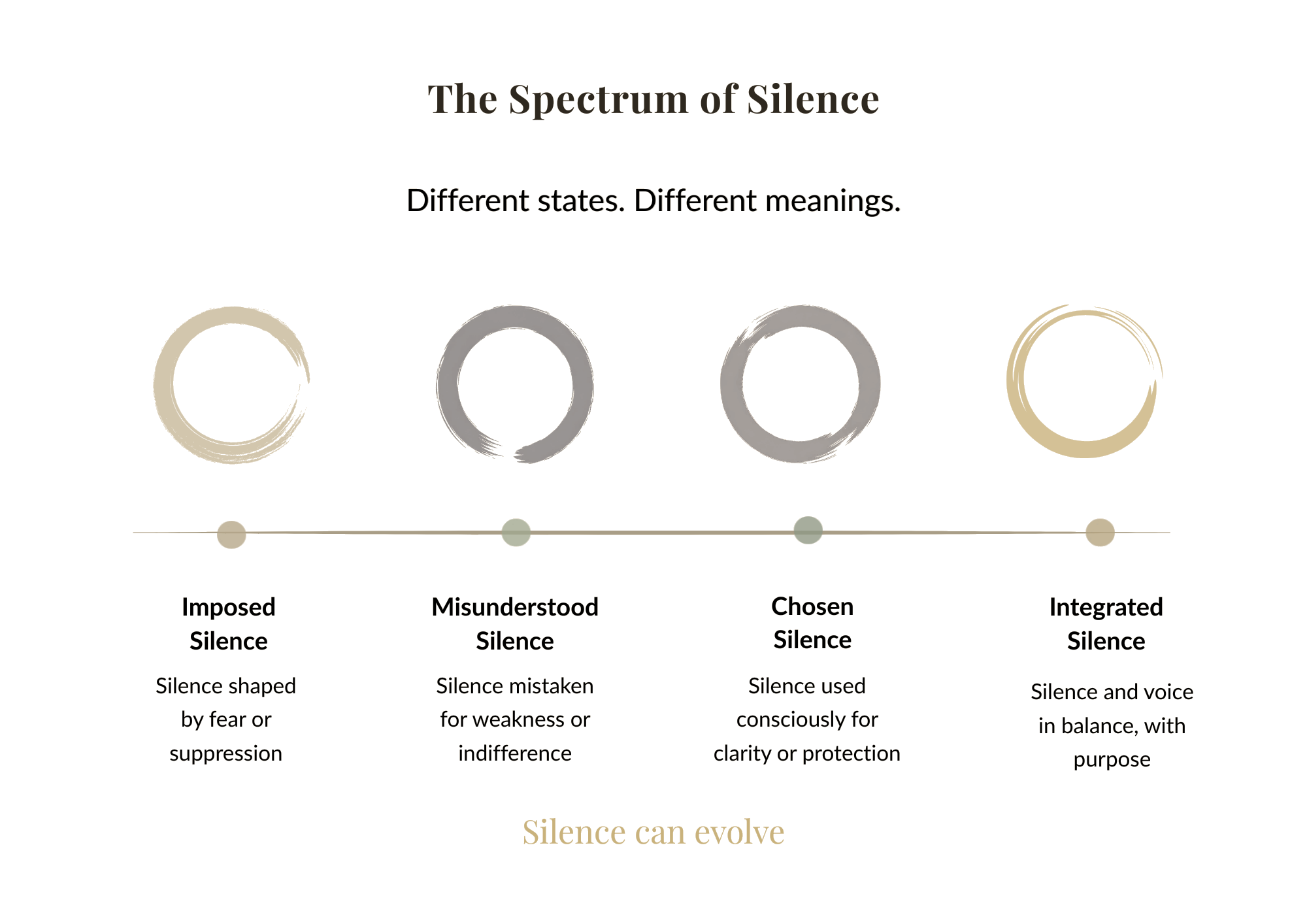
It challenges the assumption that influence requires constant visibility, leadership requires dominance, or the loudest voice necessarily carries the greatest wisdom.
At its heart, Silenciology™ is not about becoming quieter.
It is about becoming more intentional about silence and voice.
Reading Silence Through People · Process · Purpose
Within Quiet Compass, I look at organizations through three interconnected dimensions: People, Process, and Purpose.
Silence can reveal something about each.
People — the heart
Who feels safe enough to disagree?
Whose contributions are visible?
Who has stopped speaking?
Silence around People can reveal trust, dignity, belonging — or their absence.
Process — the backbone
Where are people compensating for unclear systems?
Which workarounds have quietly become permanent?
What confusion has become so familiar that nobody questions it anymore?
Silence around Process often hides friction people have simply learned to absorb.
Purpose — the compass
Do people understand why the work matters?
Do everyday decisions reflect the organization’s stated values?
Is the organization moving with intention, or simply producing more?
When Purpose becomes disconnected from daily reality, people may continue performing while quietly disengaging from meaning.
These dimensions rarely drift independently. When one begins to strain, the others often compensate — allowing an organization to keep functioning while concealing deeper misalignment.
From Unconscious Silence to Intentional Silence
Silenciology™ considers silence as something that can evolve.
Unconscious Silence
Silence shaped by fear, suppression, habit, or survival.
Awakened Silence
Recognizing the dynamics that have kept something unspoken.
Intentional Silence
Consciously choosing when to pause, observe, listen, or speak.
Integrated Silence
Silence and voice working together fluidly, ethically, and with purpose.
The goal is not to eliminate silence.
A workplace where everyone is constantly encouraged to speak can become another kind of performance.
The goal is to create conditions where people do not have to calculate the personal cost of telling the truth — and where thoughtful silence is respected rather than automatically interpreted as disengagement.

What Leaders Can Notice
You do not need a new survey to begin.
Start by observing.
Where does the real conversation happen after the meeting?
Who speaks early, and who waits?
Who is frequently relied upon but rarely acknowledged?
Where are people compensating for ambiguity?
What has your organization become so accustomed to that nobody names it anymore?
These are not conclusions.
They are invitations to look more closely.
Because the purpose of listening to silence is not to diagnose people.It is to understand the conditions in which they are working.
Listening Before Fixing
Silenciology™ does not replace strategy, structure, accountability, or good operational design.
It strengthens them.
A process cannot be improved if the people closest to it have learned that their observations are unwelcome.
A value cannot shape culture if employees experience something entirely different.
A leader cannot create genuine alignment by asking for agreement.
Sometimes the first intervention is not another initiative.
It is listening long enough to understand what the organization has been trying to tell you.
Quietly.
All along.
A Quiet Manifesto
We live in a world accustomed to noise.
Silenciology™ is an invitation to notice what noise can obscure.
To listen before reacting.
To pause before performing.
To question before assuming.
To lead without ego.
To restore dignity to people,
clarity to processes,
and meaning to purpose.
Silence, when chosen consciously, can become a form of courage.
You do not need to be loud to be powerful.
And people should not have to become louder simply to be heard.